

On New Year’s Eve I treated myself to a new guitar. And when it arrived two weeks later, I somehow realised that I must have had forgotten a thing or two over the last 25+ years that I hadn’t played. What a surprise! Not even “stairway to heaven” – the one track one must play in a music store (except for Cassel’s Music if you remember Wayne’s World) …

So, I had to do it all over again. Music theory, chords, patterns – the whole nine yards! I grabbed myself a license of GuitarPro (no affiliation) and started with the very basics. And then I came across the Circle of Fifths. Interestingly, a quarter century later I could make more sense out of it. In the process of regaining my muscle memory I expanded the circle with some hints for scale patterns as you can see below.
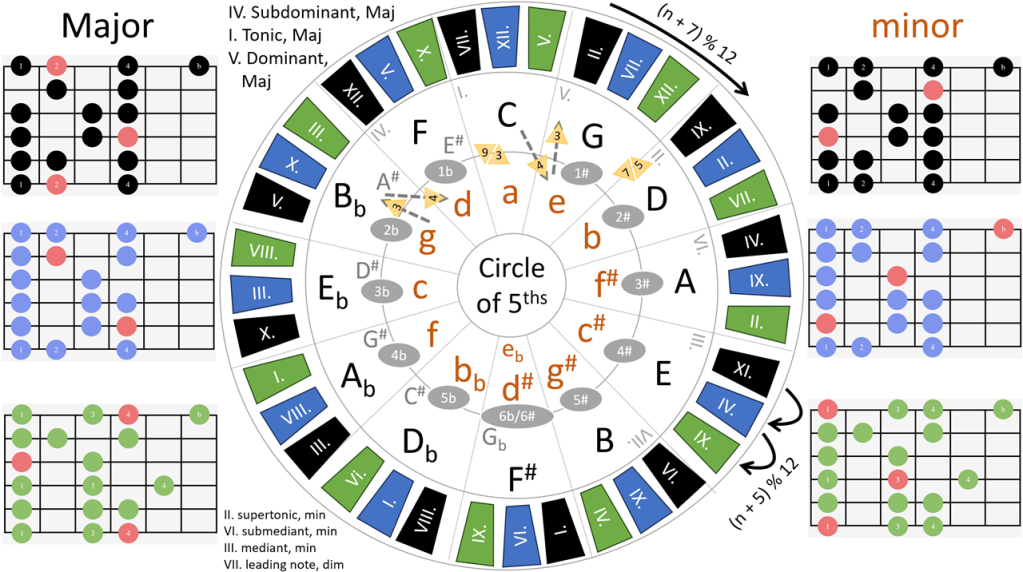
I am not going into the basics of the circle, there is plenty of information about this available. However, I will quickly describe what I added: For every scale I noted down three patterns (from the long list below) that are relatively easy to execute. Their colours are black, blue and green, respectively. The red notes mark the start of the scale. The alternating black, blue green ring placed around the major chords contains the numbers on the fret board on where to start with the index finger. Every pattern moves 5 frets from the previous pattern up the frets with XII. being the highest fret. From there it starts at I. (n' = (n + 5) % 12). Between scales we move up 7 frets (n' = (n + 7) % 12).
For example C Major: the black pattern starts at fret VII. (7), blue at XII. (which is 12 = 7 + 5). With the green pattern the it wraps around to start at V., as 17 = 12 + 5, and 5 = 17 - 12). The next scale G Major then starts the black pattern at II., as 14 = 7 + 7, and 2 = 14 - 12. And from there the other coloured patterns can be calculated as before.
I also added a hint regarding tonic, subdominant, etc. (with all Major scales starting with a capital letter and the minor scales lowercase in dark orange) but this is something that can be found on other circles as well.
Each of the coloured patterns consists of 18 notes (not necessarily starting at the base note, which is – as previously mentioned – painted in red. In order to play the last note, one either has to bend up a full note, or slide up.
I found the diagram useful as it allowed me to more easily visualise and remember the scales and maybe someone else on the same journey as I does so as well.

 appclusive