Today, I write about how I built an 8 channel wireless IEM system in a 4U form factor.
The Past
A couple of years ago, I bought a Sennheiser ew IEM G4 to be used in my Sound Devices Scorpio; my microphone, MIC, rack. With this, I could either receive a single wireless stereo mix or two separate wireless mono mixes which Sennheiser calls “focus mode”. For all other mixes I used four Behringer P16-M personal mixers with wired headphones on my Behringer X32 Rack; my front-of-house, FOH, rack.
Three years later, I wanted to extend the number of wireless channels and have a solution that could be used independently of any rack with either DANTE or AES50.
The Solution
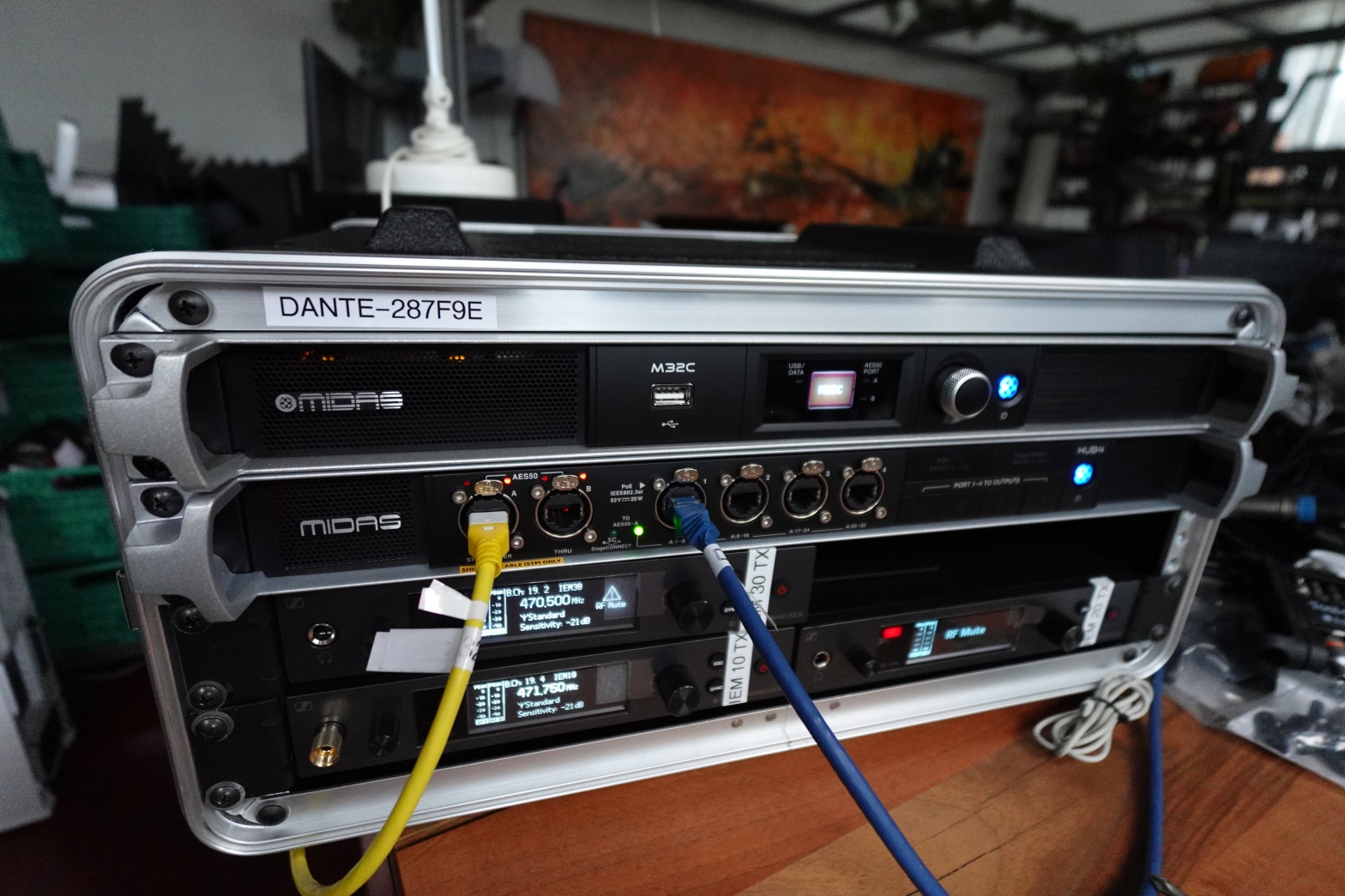
After some thinking back and forth, I decided to do a complete redesign and not use another X32 Rack and not continue to use the P16-M mixers either. Instead, I went for a Midas M32 C with a Midas HUB 4 and four Midas DP-48 personal mixers. All of that would feed four Sennheiser ew IEM G4 transmitters sharing a single transmitting antenna.
The Requirements
To better understand why I chose this setup I list my 15 requirements that had to be met by the new solution:
- The new IEM rack and the existing FOH and MIC rack can be separated by more than 50m;
- Be able to connect with a single cable to either of the racks;
- Minimise re-cabling when using with either FOH or MIC rack;
- Be able to extend the IEM rack to use it as a stage mixer;
- Be able to connect our 48×40 stage box the IEM rack;
- Be able to use all three racks at the same time;
- Be able to use up to 4 stereo or 8 mono wireless IEM channels;
- Be able to use up to 8 separate personal monitor mixes selectable from at least 16 channels each;
- Be able to remotely control personal mixes;
- Reduce interference between separate IEM transmitters;
- Do not rely on wireless radio transmission in the 2.4GHz or 5GHz band;
- Have low latency to be usable for vocals;
- Be able to use talkback between talents and sound engineer;
- Be able to route talkback from other sources to the personal mixers and wireless IEMs;
- Support ambient sound to ease listening with in-ear headphones.
The Build
As mentioned already, the system will be built around a Midas M32C that accepts input either via AES50 or DANTE. For the latter, we swap the standard USB expansion card with the X-Dante card that allows for a 32×32 routing into and out of the mixer. When connected with the MIC rack DANTE will be used for input and output. When used with the FOH rack AES50 will be used. In both cases, DANTE can also be used in either setup for providing output channels to other interested devices.
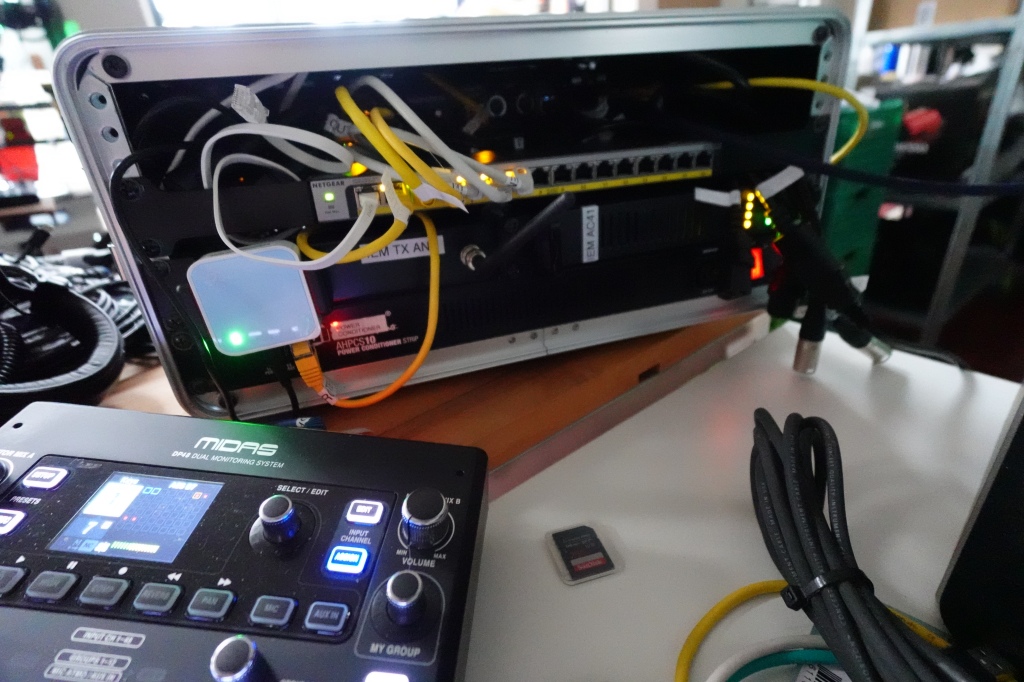
The Midas DP48 personal mixers replace our existing Behringer P16-M mixers as they offer many advantages. As each DP48 supports 2 stereo mixes, we can either use half the number of personal mixers for talents, in comparison to the P16-M, or create 8 mono mixes from 4 personal mixers. In addition, we can route the talkback functionality of the DP48 back into FOH or anywhere else via AES50 and DANTE. Channel and group assignment can be done from either the M32C or via the DP48 which is connected to Port 1 of the HUB 4.
We then connect the 8 Sennheiser transmitters inputs to the physical outputs of the HUB4 but only use inputs marked as channels 33 and 34, 37 and 38, 41 and 42 and 45 and 46.
We add our network switch and router and configure the local network to be 169.254.002.000 with a subnet mask of 16 bits. By this any DHCP client or APIPA client receives a network address in the same network.
Everything is then connected to the power conditioner and packed into a plastic 4U rack case. And this is all regarding the build.

The Routing
To make this setup work we have to configure the routing on the M32C.
- First, we route channels 01 to 32 from incoming AES50-A to outgoing AES50-B, which is then downstreamed to the HUB 4.
- We then route AES50-B upstream from HUB 4 channels 1 and 2, 5 and 6, 9 and 10, 13 and 14, 17 and 18, 21 and 22, 25 and 26 and 29 and 30 to “user input” channels 01 to 16. These are the channels that contain the personal stereo mixes of the four DP48.
- This “user input” is routed to input channels 01 to 16. Each input channel pair is configured as a linked stereo pair.
- Every four input channels are routed left and right to 2 stereo linked mix buses. Channels 01 to 04 to MixBus 01 and 02, channels 05 to 08 to MixBus 03 and 04, channels 09 to 12 to MixBus 05 and 06 and channels 13 to 16 to MixBus 07 and 08.
- These mix buses 01 to 08 are then mapped to outputs 01 to 14, skipping every third and fourth output.
- The outputs 01 to 14 are finally routed to AES50-B channels 33 to 46, which are then downstreamed back to the HUB 4 where they are sent to the physical outputs 01 to 14.
- On the HUB 4, we make sure that the DP48 are only sent upstream to the M32C and not sent to the physical outputs by activating the AES50 button until it lights up green and deactivating the port buttons until they light up white.
The Parts
Here are the 13 main parts used in the build:
- Thomann 4U Rack Case; very cheap
- Adam Hall AHPCS10 power conditioner
- Netgear GS116LP 16 port network switch
- TP-Link TL-WR802N WLAN router with one RJ45 port, powered via USB
- Midas M32C; 1U rack mixer without physical inputs or outputs
- Behringer X-Dante expansion card; to be used in the M32C as a 32×32 DANTE interface
- Midas HUB 4; 1U distributor for DP48 personal mixers; in addition with a total of 16 balanced outputs; 4 XLR and 12 6.35mm TRS; also powers the personal mixers via AES50
- 4 Midas DP48; personal mixer with 2 stereo mixes, 12 groups selectable from 48 channels, with ambient microphone, talkback, AUX input und SD recorder that supports mix-minus
Sennheiser AC41; combines 4 IEM transmitter into one antenna and also feeds power to the transmitters - 4 Sennheiser ew SR IEM G4-A1 stereo transmitter; 1U half rack size, support frequency management via network
- 6 Sennheiser ew EK IEM G4-A1 stereo receiver; support mono, stereo or “focus” mode; with 3.5mm TRS output
- Sennheiser U1031 passive omnidirectional antenna; can be connected to the AC41 to get better coverage of and signal on the recievers
- 6 CCA 3.5mm IEM headphones
- And of course: a bunch of cables …
The Performance
I did some latency tests to see how long the signal takes from the microphone to the actual wireless receiver. In my tests the latency was slightly over 2.06 ms. You can read more about it in Latency Test with a Wireless Microphone, through a DP48 Personal Mixer and a Wireless IEM. So, it is quite usable in my opinion. Even when singing the latency is hardly perceivable at all.
The Summary
We now have a very versatile wireless IEM rack with up to 8 channels in a very small form factor. This could be scaled horizontally to even a larger number of channels by adding some more of these 4U racks to the setup. The sound quality is ok. Maybe a digital system would be better, but then a latency increase of an additional 2 ms should be expected.
The “missing” console is ok. I hardly change anything on the mixer at all. Only when switching between DANTE and AES50 or when switching between mono and stereo mixes a scene change is needed. Everything else can be configured directly on the primary DP48.
With the Klark Teknik DN9630 I can even use this IEM rack via USB from a PC, if I do not want to use a Dante Virtual SoundCard. And if I ever need to add physical inputs or outputs I can connect a stagebox via AES50 or Ultranet; the latter if I only want to connect more physical outputs.
And this is it for today. Thanks for reading.
Corrigendum / Addendum
./.
 appclusive
One thought on “A Dante/AES50 enabled 4U mixer rack for 8 wireless IEM channels”