
In this post I describe how we extended our Behringer Wing with an additional 48 inputs and 40 outputs via AES50 in a 4U rack case.
The Summary
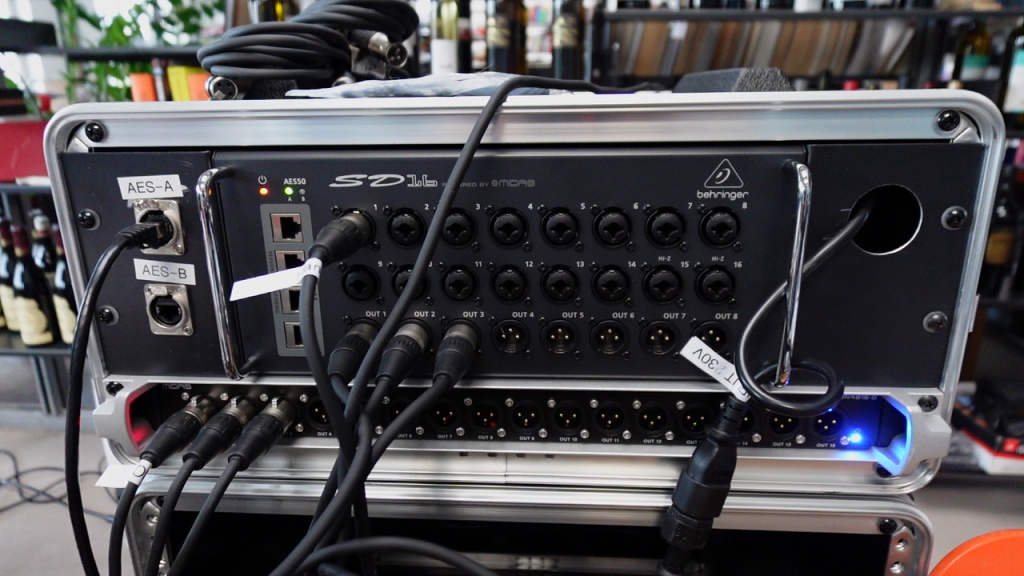
The rack case consists of a Behringer SD16 that connects to a Behringer S32 via AES50. In addition, we connect a Midas DN4816-O via its Ultranet input to the Behringer S32. From there all 48 inputs are upstreamed to and all 40 outputs are downstreamed from the Behringer Wing via AES50. All rack parts are powered through the Adam Hall PCL 10 Power Conditioner.
The Configuration
As AES50 supports 48×48 channels we needed to find a combination of stage boxes and modules that would come close to this maximum. We started with a Behringer S32 as the main item of the extension, as this stage box supports 2 AES50 ports and an Ultranet output. We then added a Behringer SD16 (instead of a Behringer S16) for two reasons:
- We already had a spare SD16 catching dust in a shelf for quite some time.
- In contrast to the S16, the SD16 supports XLR/TS combo input jacks.
The downside to this is the larger form factor (3U vs 2U with the S16). The 4 Ultranet ports are not needed either. By combing these two stage boxes we reach a 48×24 channel count. That is why we added a Midas DN-4816-O reaching a final channel count of 48×40.
Note: In order to reach the maximum 48×48 channel count one *could* have added a Behringer ADA8200. However, this would have consumed another unit in the rack and added roughly 25 CHF/30USD per output port along with some additional complexity and latency.
To make this setup work we need to configure a few things:
- On the DN4816-O we need to switch to
UltranetandIndividual; - The SD16 connects via its AES50-A to the AES50-B port of the S32;
- On the SD16 we need to switch
OUTto17-24; - We connect the S32 via AES50-A to a free AES50 port on the Behringer Wing;
- The console needs to define a sync source and provide it to the S32; we set our to the
DANTEmodule (orINTERNALif we had no Dante); - The console needs to route (up to) 40 output channels downstream via its AES50 port to the S32;
- The console needs to route (up to) 48 input channels upstream from its AES50 port from the S32.
As we are using the SD16, which comes with 4 powered Ultranet ports, we could use these to connect an additional DN4816-O to use as a signal splitter for ports AES50-33 to AES50-48. Or we could run a Cat5e cable to a P16-M and connect remote speakers via unbalanced 1/4″ TS line out.
With this setup, the routing and port assignment would look similar to the tables below. The good thing: we do not need a Wing for this. We can use our X32 RACK or the Midas M32C (or any other X32/M32 with AES50 for that matter) or even a Klark Teknik DN9630 as well.


For additional information on how these stage boxes can be connected and route their AES50 channel, have a look at the Behringer documentation. There you find useful diagrams like the one below:

The Test
So, one question remains: what is the performance (as in latency) hit we get by using such a stage box? Can we use it as a digital patch bay? Let’s do some testing …
The Setup
With our test case below we have 3 input signals and generate 18 output signals (1A, 1B, 1C, …, 1E, 2A, …, 3E) all running at 48kHz:

Connect a Roland TR8-S with
- ( 1 ) BD/ASSIGN1 to the Behringer Wing,
- ( 2 ) SD/ASSIGN2 to the input of the S32,
- ( 3 ) LT/ASSIGN3 to the input of the SD16 (all instruments being a
909 Bass2with the same parameters).
Route the signal
- ( A ) to the output of the Wing,
- ( B ) to the output of the S32,
- ( C ) to the output of the SD16,
- ( D ) to the output of the DN4816-O and
- ( E ) to the DANTE output
Connect all these outputs to the Sound Devices Scorpio as line input and record the sound.
The Result

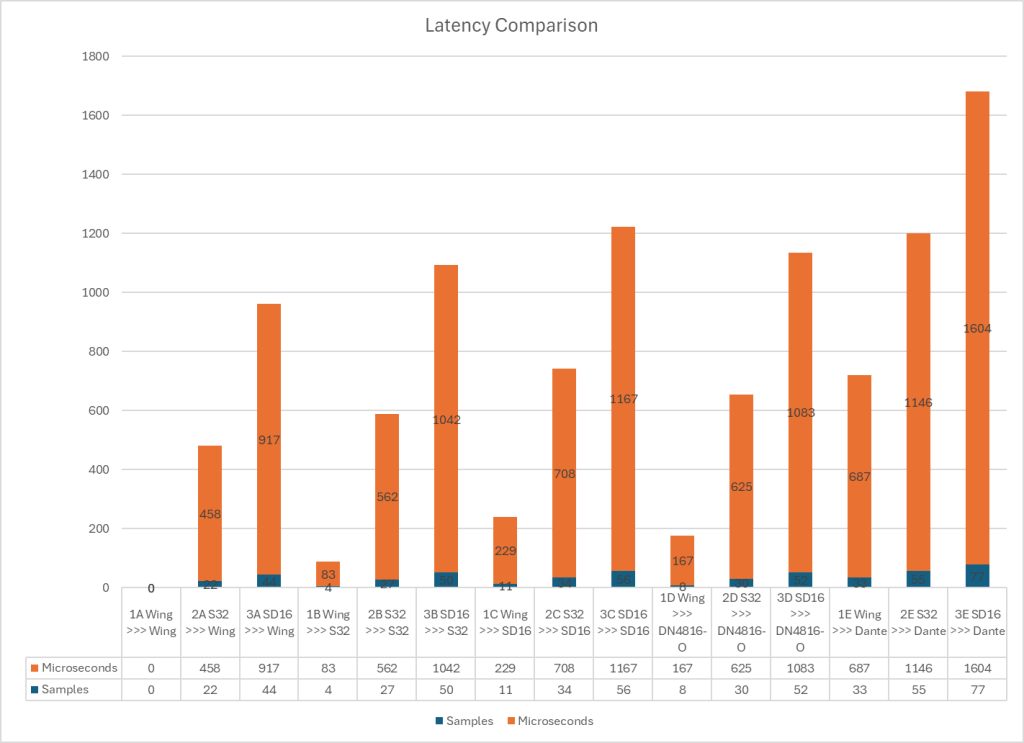
Below you find a summary with the results. Some observations:
- Not surpisingly the direct connection to and from the Wing is the fastest.
- Connections to and from the SD16 have twice the latency as connections from and to the S32 due to the fact that the signal must change from one AES50 port to the other (adding 22 samples).
I did a couple of recordings and uploaded one of them so you can have a look for yourself.
| Relative Latency | Inputs | ||
| Output | ( 1 ) Wing | ( 2 ) S32 | ( 3 ) SD16 |
| ( A ) Wing Analogue (CH01 – CH03) | 0smp / 0us | 22smp / 458us | 44smp / 917us |
| ( B ) S32 (CH04 – CH06) | 4smp / 83us | 27smp / 562us | 50smp / 1042us |
| ( C ) SD16 (CH07 – CH09) | 11smp / 229us | 34smp / 708us | 56smp / 1167us |
| ( D ) DN4816-O (CH10 – CH12) | 8smp / 167us | 30smp / 625us | 52smp / 1083us |
| ( E ) Wing Dante (CH13 – CH15) | 33smp / 687us | 55smp / 1146us | 77smp / 1604us |
The Parts
- Behringer S32
3U, 32 mic pre-amps XLR inputs, 16 balanced XLR outputs, 2 AES50, 1 Ultranet output - Behringer SD16
3U, 16 mic pre-amps XLR/TRS combo inputs, 8 balanced XLR outputs, 2 AES50, 4 powered Ultranet outputs - Midas DN4816-O
1U, 16 balanced XLR outputs, 1 Ultranet input, 1 StageConnect Master, 1 StageConnect Slave - Adam Hall PCL 10 Power Conditioner
1U, 10A, 1 AC IEC input, 8 fused and switched AC IEC outputs, 1 unfused and unswitched AC IEC output - Thomann Rack Case 4U
4U, 400mm - Cat5e Cable
10m shielded cable with Neutrik etherCON connectors to connect the extension with an AES50 clock master
The Price
Below you find a price indication of the components used in the build (with exchange rates at the time of writing).
| 1 | 1.04136 | 0.89012 | 1.13897 | |
| CHF | EUR | GBP | USD | |
| S32 | 880 | 916.3968 | 783.3056 | 1002.2936 |
| SD16 | 580 | 603.9888 | 516.2696 | 660.6026 |
| DN4816-O | 300 | 312.408 | 267.036 | 341.691 |
| Power Conditioner | 135 | 140.5836 | 120.1662 | 153.76095 |
| 4U Rack Case | 85 | 88.5156 | 75.6602 | 96.81245 |
| Cat5e Cable | 25 | 26.034 | 22.253 | 28.47425 |
| Sum | 2005 | 2087.9268 | 1784.6906 | 2283.63485 |
The Conclusion
For roughly 2000 CHF (2100 EUR, 1785 GBP, 2280 USD) we get a total of 88 ports with 48 (!) microphone pre-amps (and yes, their quality is not outstanding, but defninitely usable) and a whole bunch of XLR/TRS combo jacks.
The overall latency is still incredibly and unnoticable low with the inputs and outputs on the SD16 being the slowest. It is interesting to see how fast Dante is in comparison to AES50.
 appclusive
if im not mistaken with this setup you would still only be able to do 16 iem outputs correct?
LikeLike
Hi Eric, I am not sure if I understood your question correctly. This extension box “only” adds additional I/O ports. If you are referring to my IEM article (https://appclusive.net/2024/04/02/a-dante-aes50-enabled-4u-mixer-rack-for-8-wireless-iem-channels/) where I built a box for 8 IEM channels, the setup in this article is completely unrelated.
However thinking about it, if you needed more IEM channels you _could_ add more of these IEM boxes to the Wing (via Dante or AES). The Wing has 3 AES50 ports which means you could directly connect 3 of these IEM boxes giving you a total of 24 IEM channels where each IEM box could receive an individual 32 channels from the upstream Wing. And if you daisy-chained the IEMs you could potentially add more boxes but were still constrained to 32 individual channels per AES port.
However, you would be more flexible with Dante which gives you a higher channel count by only using a single phyical ethernet port on the Wing. With this, you would still have enough free I/O on the Wing itself to connect your actual sources. But after all, the Wing is still “only” a 48 channel mixer.
And of course, if you just needed more IEM receivers sharing the same IEM configuration you can just add more to the IEM box without any reconfiguration and tune them to the same frequency.
All in all, I do not know if this setup would be the cheapest to go, or if there are other options if you need a (much) higher IEM channel count.
Please tell me, if this helped and if I understood you correctly or otherwise please rephrase and give more details so I can better answer your question.
Ronald
LikeLike